
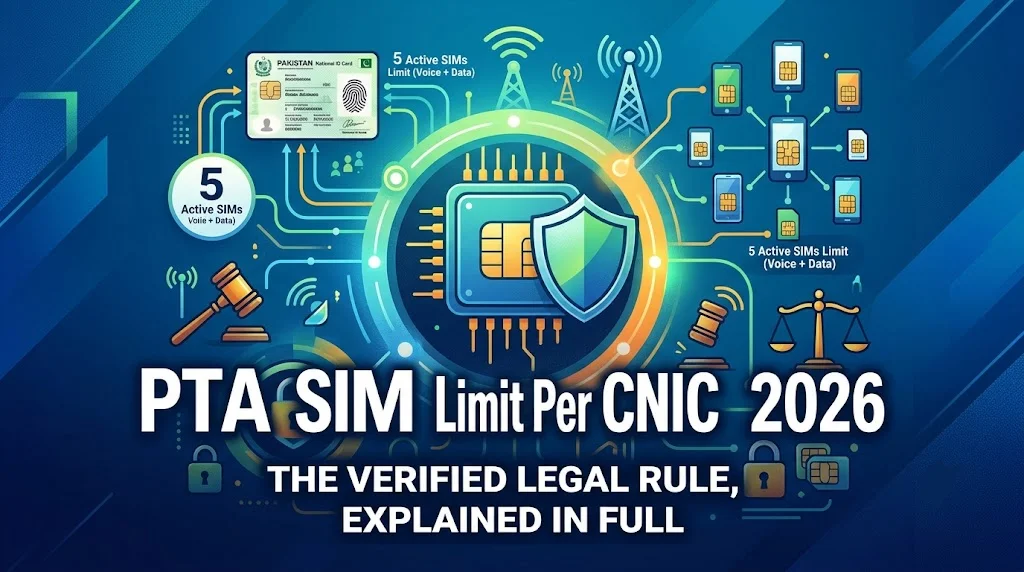
Few questions about Pakistani telecom regulation generate as much conflicting information online as “how many SIMs can I have on my CNIC?” This guide gives you the verified, court-established answer, traces exactly where that rule came from, explains what happens if you exceed it, and shows you how to check your current count using official channels — not guesswork or outdated blog posts.
For the complete picture on checking your own SIM registrations, see our flagship SIM Owner Details guide.
Quick Answer
The legal limit is 8 SIMs total per CNIC: a maximum of 5 voice SIMs plus a maximum of 3 data-only SIMs, combined across all operators. This is not an estimate or a marketing figure — it comes directly from a Supreme Court of Pakistan ruling. The Court first capped SIMs at five per CNIC in 2012 for security reasons, then on 5 November 2015, in a case brought by CMPak (Zong) before a bench headed by Chief Justice Anwar Zaheer Jamali, the Court allowed an additional three data-only SIMs on top of the original five-voice cap — arriving at the 5+3=8 figure that remains the law today.
Where This Rule Actually Comes From
Understanding the origin of the SIM limit matters, because it explains both why the rule exists and why it’s structured the way it is:
2012 — The Original Five-SIM Cap. In the aftermath of security concerns tied to anonymously registered or fraudulently obtained SIMs, the Supreme Court of Pakistan capped SIM registrations at five per CNIC. The reasoning was straightforward: reducing the number of connections any single identity could hold made it harder to build large networks of anonymous or loosely-tracked mobile numbers for illicit purposes.
2015 — CMPak’s Petition and the Data SIM Exception. China Mobile Pakistan (Zong) subsequently brought a case before the Court arguing that data-only SIMs — used in routers, MiFi devices, tablets, and similar equipment — served a fundamentally different purpose than voice SIMs and shouldn’t be counted against the same restrictive cap. On 5 November 2015, the Court agreed, permitting an additional three data-only SIMs on top of the existing five-voice limit. This ruling is the direct origin of the combined 5+3=8 structure that governs SIM registration in Pakistan today.
This history is worth knowing because it explains a detail many citizens miss: the limit isn’t simply “8 SIMs” as an undifferentiated total — it’s specifically 5 voice plus 3 data, and the two categories are tracked separately even though they combine to the same overall cap.
A Common Misunderstanding to Avoid
Some sources online incorrectly describe the limit as “5 SIMs per network,” implying a citizen could theoretically hold 25 SIMs across five operators. This is incorrect. The cap of 8 total SIMs (5 voice + 3 data) is combined across all operators together — Jazz, Zong, Telenor, Ufone, and SCO combined, not per individual network. If you already hold 3 voice SIMs on Jazz and 2 on Zong, you have reached your full 5-voice-SIM allowance and cannot register a new voice SIM on Telenor, Ufone, or any other network until you disown one of your existing connections.
How to Check Your Current SIM Count
Before worrying about whether you’re near or over the limit, check your actual current registration count:
- SMS your 13-digit CNIC (no dashes) to 668 from any Pakistani mobile number.
- Review the operator-wise breakdown in the reply — it shows your total SIMs by network.
- For a detailed, dated, printable record, visit cnic.sims.pk and enter your CNIC.
- Add up your total and compare it against the 5 voice + 3 data structure — remember to check whether any of your registered SIMs are data-only devices you may have forgotten, such as a home router or tablet SIM.
Our full SIM Owner Details guide covers these methods, along with ten additional official verification tools, in complete depth.
What Happens If You Exceed the Limit?
If your registered SIM count exceeds the legal 5+3=8 structure, PTA’s enforcement systems are designed to flag and eventually restrict further registration under your CNIC. In practice:
- You will not be able to register a new SIM on any network once you’ve reached your full voice or data allowance, until you formally disown an existing connection.
- Existing SIMs beyond the limit — for example, if you somehow ended up with 6 voice SIMs due to a registration error or unauthorized SIM — may face review or suspension during PTA’s periodic enforcement sweeps.
- You should proactively disown any SIM you don’t need, rather than waiting for enforcement action, since voluntary compliance avoids any disruption to the connections you actually want to keep.
If you discover you’re over the limit due to a SIM you don’t recognize rather than one you knowingly registered, our dedicated Unknown SIM Registered on My CNIC guide walks through the complete investigation and removal process.
PTA’s Ongoing Enforcement in 2026
PTA continues to actively enforce SIM registration compliance well beyond the basic 5+3=8 count. According to PTA’s own enforcement data covering July 2024 to June 2025, working alongside the National Cyber Crime Investigation Agency (NCCIA), the regulator blocked more than 3.2 million SIMs registered against deceased individuals’ CNICs, removed 783,000 SIMs linked to expired CNICs, and disabled 69,000 SIMs issued against cancelled or impounded CNICs — figures that illustrate just how actively PTA monitors compliance beyond simple headcounts.
This enforcement activity has continued through 2026, with PTA repeatedly advising citizens to confirm their CNIC remains valid and current, since SIMs linked to expired, cancelled, or deceased holders’ CNICs face blocking as part of this ongoing campaign.
The New 365-Day SIM Disowning Rule
A critical recent change affecting anyone managing their SIM count: on 24–25 May 2026, PTA officially extended the SIM disowning and transfer period from 60 days to a full 365 days from a SIM’s activation date. This means that if you register a new SIM to stay within your limit, you cannot formally disown or transfer it for a full year afterward — making it more important than ever to think carefully before registering a new connection, since you’ll be committed to it for a longer minimum period than under the previous rule.
Biometric Verification and the SIM Limit
Every SIM counted toward your 5+3=8 limit is registered through mandatory biometric verification — your fingerprint (and increasingly facial scan) is matched against NADRA’s central database at the point of activation. This is why simply photocopying a CNIC isn’t sufficient to register a new SIM under current rules; the physical presence and biometric confirmation of the CNIC holder is required, which significantly reduces (though doesn’t entirely eliminate) the risk of someone registering a SIM against your identity without your direct involvement.
Practical Advice for Managing Your SIM Portfolio
Given the 5+3=8 structure and the 365-day disowning commitment, a few practical habits help most citizens stay comfortably within their limit while avoiding unnecessary friction:
- Run a 668 check before registering any new SIM to confirm you have room within your voice or data allowance.
- Disown genuinely unused old SIMs proactively, rather than letting them accumulate toward your limit indefinitely.
- Distinguish clearly between voice and data-only SIMs in your own mental tally, since they draw from separate sub-limits within the combined 8-SIM cap.
- Think carefully before registering a new SIM given the 365-day minimum commitment introduced by PTA’s May 2026 policy update.
SIM Limits Across Different Networks
The 5+3=8 combined limit applies identically regardless of which operators you use. Whether your SIMs are spread across Jazz, Zong, Telenor, Ufone, or the newer ONIC brand, they all draw from the same shared allowance. Our network-specific guides — Jazz SIM Owner Details, Zong SIM Owner Details, and Telenor & Ufone SIM Check — cover the specific verification codes for each operator, all of which feed into the same overall count you check via 668.
Is There a Different Limit for Businesses or Special Cases?
Corporate or business SIM registrations, where a company holds a commercial account rather than an individual CNIC-linked registration, generally follow a separate framework from the personal 5+3=8 limit discussed in this guide. If you’re registering SIMs for business purposes at scale, this typically requires a distinct corporate account setup through the relevant operator, rather than counting against any individual employee’s personal CNIC allowance — though always confirm the specific arrangement with your chosen operator, since exact corporate account structures can vary. Employees provided with a company-issued SIM under a corporate account generally do not see that connection reflected in their own personal 668 check, since it’s registered against the company’s commercial identity rather than the individual’s CNIC — a distinction worth clarifying with your employer if you’re ever unsure whether a work-provided SIM affects your personal allowance.
How the Limit Compares Internationally
Pakistan’s approach to SIM registration limits isn’t unique globally, though the specific 5+3=8 structure and its court-driven origin are distinctly Pakistani. Many countries with significant SIM-based fraud or security concerns have implemented similar per-identity registration caps — the underlying logic is consistent: limiting how many anonymous or loosely-tracked communication channels a single identity can control makes it harder to build networks for fraud, harassment campaigns, or more serious criminal activity, while still allowing legitimate citizens reasonable flexibility for personal, family, and data-device needs. Pakistan’s specific choice to separate voice and data allowances, driven by Zong’s successful 2015 litigation, reflects a relatively citizen-friendly refinement compared to a flat, undifferentiated cap that might not account for the genuinely different use case of router and device SIMs.
The Relationship Between SIM Limits and CNIC Validity
Your ability to register new SIMs — and to remain within your legal limit without complications — depends directly on your CNIC being current and valid. An expired CNIC can create friction during new SIM registration attempts, since biometric matching against an expired record can fail validation checks at the franchise level. This is one of several reasons our CNIC Information hub and dedicated CNIC renewal resources emphasize keeping your identity documents current as a foundational habit — SIM limit management and CNIC currency are genuinely interconnected aspects of the same overall identity infrastructure, not separate concerns.
What Counts as a “Data-Only” SIM in Practice
The distinction between voice and data SIMs matters directly for how you calculate your remaining allowance, so it’s worth being precise about what qualifies:
- Data-only SIMs: SIMs specifically provisioned for internet-only use in routers, MiFi devices, tablets without calling capability, and similar IoT equipment. These draw from your separate 3-SIM data allowance.
- Voice SIMs: Any SIM capable of making and receiving calls and SMS, regardless of whether you primarily use it for data — a standard smartphone SIM with a full voice/SMS/data plan counts as a voice SIM even if you rarely make calls on it.
If you’re unsure which category a specific SIM falls into, your operator’s franchise staff can clarify based on the specific plan or package associated with that connection.
Frequently Asked Questions
What is the exact legal SIM limit per CNIC in Pakistan? 8 SIMs total: a maximum of 5 voice SIMs plus a maximum of 3 data-only SIMs, combined across all operators, per a Supreme Court ruling dated 5 November 2015.
Is the limit 5 SIMs per network or 5 SIMs total? 5 voice SIMs total, combined across all networks together — not 5 per individual operator.
Why does the limit include a separate data-SIM allowance? Because CMPak (Zong) successfully argued before the Supreme Court in 2015 that data-only SIMs for routers and similar devices serve a different purpose than voice SIMs and shouldn’t count against the same restrictive cap.
How do I check my current SIM count? SMS your 13-digit CNIC to 668 for an operator-wise breakdown, or visit cnic.sims.pk for a detailed, dated record.
What happens if I exceed the limit? You won’t be able to register new SIMs until you disown an existing one, and PTA’s periodic enforcement sweeps may flag or suspend connections beyond your allowance.
Can I disown a SIM immediately if I need to register a new one? Under PTA’s May 2026 policy, SIMs activated after that date cannot be formally disowned for 365 days from activation — plan your registrations with this in mind.
Does the limit apply to ONIC SIMs separately from Ufone? No — since ONIC is operated by the same company (PTML) as Ufone, connections on both brands draw from the same combined allowance.
Are business/corporate SIMs counted the same way? Generally no — corporate accounts typically follow a separate registration framework from the personal CNIC-linked limit, though always confirm with your operator.
What does PTA do to enforce this limit? PTA runs periodic enforcement sweeps and, per its own data, blocked millions of SIMs linked to deceased, expired, or cancelled CNICs in a single recent enforcement cycle alone, demonstrating that this isn’t a rule that exists only on paper.
Can I hold 3 data SIMs even if I already have 5 voice SIMs? Yes — the voice and data allowances are separate sub-limits within the combined 8-SIM total, so reaching your 5-voice cap doesn’t affect your separate 3-data-SIM allowance, meaning you can still register a router or MiFi SIM even after maxing out your voice lines.
Final Word
Pakistan’s SIM-per-CNIC limit is one of the more precisely documented rules in the country’s telecom regulatory framework, tracing directly to a specific, named Supreme Court case rather than vague policy. Understanding the real 5+3=8 structure — and the newer 365-day disowning commitment introduced in May 2026 — helps you manage your own SIM portfolio deliberately rather than reactively. For the complete toolkit on checking and protecting your SIM registrations, see our SIM Owner Details guide, and for the broader identity-verification picture, our CNIC Information hub.
Perhaps the most practical takeaway from this entire guide is simple: most Pakistani citizens never come close to their actual 8-SIM limit, and the rule exists primarily to prevent large-scale abuse rather than to constrain ordinary household use. Understanding the exact structure — rather than relying on rumor or incomplete online summaries — means you can make informed decisions about your own SIM portfolio without either unnecessary anxiety about a limit you’re unlikely to approach, or careless disregard for a rule that genuinely does have legal weight and real enforcement behind it.
This guide is for general informational purposes and reflects publicly available Supreme Court rulings and PTA policy as understood at the time of writing. Always confirm current rules directly on pta.gov.pk. See our Disclaimer and Privacy Policy for full details. Questions? Contact Us. This page is reviewed periodically as PTA policy and enforcement practices evolve.