
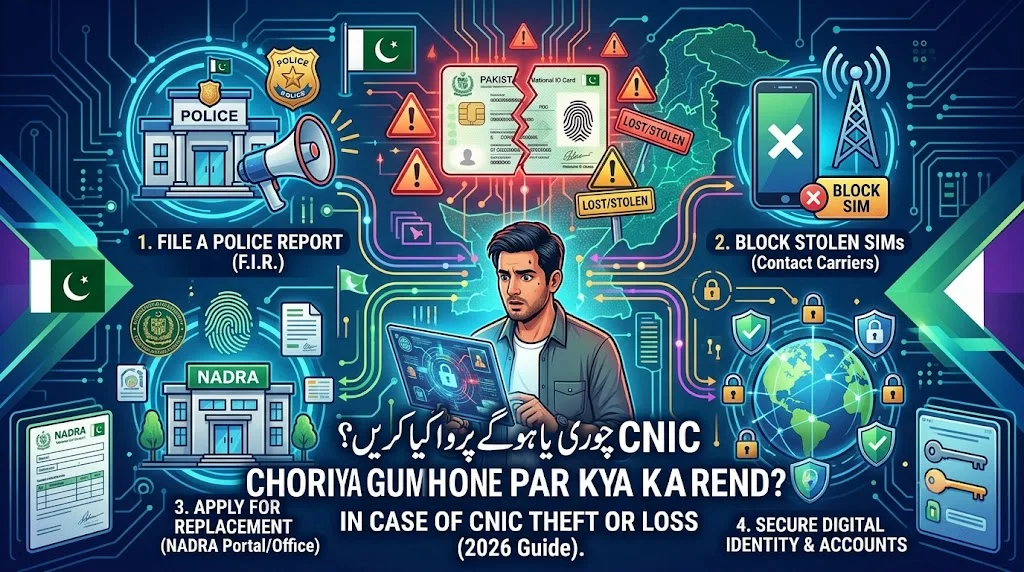
A stolen or lost CNIC is one of the most stressful identity events a Pakistani citizen can face, and the reason is simple: your CNIC number is the master key to your entire administrative life — banking, SIM registration, property, welfare programs, and dozens of other services all trace back to that single 13-digit number. The good news is that the response process is well-defined, and acting quickly and in the right order dramatically reduces your actual risk. This guide walks through exactly what to do, in the right sequence, using only official channels.
For the broader identity-protection picture, see our flagship CNIC Information hub guide and our detailed SIM Owner Details guide, since SIM fraud is the most common consequence of a stolen CNIC.
Quick Answer
If your CNIC is lost or stolen: file a police FIR immediately, inform NADRA through their official helpline, contact your telecom operators to flag your CNIC against new SIM registrations, run a 668 check to record a baseline SIM count, inform your bank(s), and apply for CNIC replacement at a NADRA centre or via the Pak-Identity portal. Speed matters — the longer a stolen CNIC circulates, the higher the risk of unauthorized SIM registration or financial fraud carried out in your name.
Why Speed Matters More Than Anything Else
Every hour a stolen CNIC remains unreported and unreplaced is an hour it can potentially be used against you. Because your CNIC number is the anchor for so many services, a person in possession of your physical card — or even just a clear photo/photocopy of it — can attempt to register SIMs, open financial accounts, or complete transactions that will later show up as officially yours, even though you never authorized them. This is precisely why the sequence and speed of your response matters as much as the individual steps themselves.
The Complete Step-by-Step Response
Step 1: File a Police FIR Immediately
This is your first and most urgent action, for two distinct reasons. First, an FIR creates an official, timestamped legal record that your CNIC was lost or stolen — this becomes critical evidence if you later need to dispute any fraudulent activity carried out using your identity. Second, some NADRA and banking processes may specifically request an FIR number as part of their own verification or replacement procedures.
What to bring: any identification you still have, and as much detail as possible about when and where the CNIC was lost or stolen. What to request: a certified copy of the FIR, and make sure to note the FIR number separately in case the physical copy is misplaced.
Step 2: Inform NADRA Through Their Official Helpline
Contact NADRA directly to report the loss or theft. This allows NADRA to flag your CNIC number in their system, which can help limit certain types of misuse and is a required step before applying for a replacement card. You can also begin this process through the Pak-Identity portal at id.nadra.gov.pk, which our dedicated CNIC Verification guide covers in complete depth.
Step 3: Contact All Major Telecom Operators
This is the step most citizens overlook, and it’s arguably the most consequential for preventing immediate financial harm. Contact Jazz, Zong, Telenor, Ufone, and any other operator you use, and request that no new SIM be registered against your CNIC without additional verification. While biometric matching already provides a significant barrier against fraudulent registration, proactively flagging your CNIC with each operator adds an extra layer of protection during the vulnerable window before your replacement CNIC is issued.
Step 4: Run a 668 Check to Record a Baseline
Before your CNIC replacement process even begins, send your 13-digit CNIC number (no dashes) to 668 and screenshot the result. This documents exactly how many SIMs were registered against your CNIC at the moment you discovered the theft — a crucial baseline for identifying any new unauthorized registrations that might occur afterward. Our full SIM Owner Details guide covers this and eleven other official verification methods in complete depth.
Step 5: Inform Your Bank(s)
Contact every bank where you hold an account, mobile wallet, or any CNIC-linked financial product. Request that your accounts be flagged for extra scrutiny during this period, and ask specifically about any additional verification steps they can apply to new transactions or account changes while your CNIC replacement is pending.
Step 6: Apply for CNIC Replacement
Once you’ve completed the reporting steps above, apply for a replacement CNIC at your nearest NADRA centre or through the Pak-Identity portal. Our detailed NADRA ID Card Renewal guide covers the exact fee structure (normal, urgent, and executive processing tiers), required documents, and step-by-step process — the same framework applies to a lost/stolen replacement, generally with the added requirement of your FIR reference.
What Happens During the Vulnerable Window
Between reporting your CNIC as lost/stolen and receiving your replacement card, you’re in what security professionals sometimes call a “vulnerable window” — your old CNIC number technically remains valid in NADRA’s system (since the number itself doesn’t change with a replacement card) but the physical card is out of your control. During this period:
- Monitor your 668 count more frequently than the usual monthly habit — consider checking weekly until your replacement CNIC arrives.
- Watch your bank and mobile wallet statements closely for any unfamiliar activity.
- Be alert to social engineering attempts — fraudsters who’ve obtained a stolen CNIC sometimes follow up with phone calls impersonating banks or NADRA to extract additional information like OTPs.
Common Mistakes That Increase Risk
Delaying the FIR
Some citizens delay filing a police report, hoping the CNIC will turn up, or feeling that the process is inconvenient. This delay directly extends your vulnerable window and can complicate later disputes over fraudulent activity, since the FIR’s timestamp is often central to establishing when the theft actually occurred.
Only Contacting NADRA, Not Telecom Operators
Many citizens report the loss to NADRA but forget the equally important step of contacting telecom operators directly. Since SIM fraud is the single most common consequence of a stolen CNIC, this omission leaves a significant gap in your protection.
Not Documenting the Baseline SIM Count
Without a documented “before” snapshot from a 668 check, it becomes much harder to prove that a specific SIM registration happened after your CNIC was stolen, which can matter significantly if you need to dispute a fraudulent registration later.
Is a Stolen CNIC the Same as a CNIC Used for Identity Theft?
Not automatically — but it’s the primary pathway. A physically stolen CNIC gives a bad actor direct access to your exact identity number, name, and other printed details, making it significantly easier to attempt fraudulent SIM registration, financial account manipulation, or other identity-based fraud than starting from scratch. This is distinct from, but related to, the risks covered in our Unknown SIM Registered on My CNIC guide, which addresses the specific scenario of discovering an unauthorized SIM regardless of how the underlying fraud occurred.
The Legal Framework Protecting You
If your stolen CNIC is used to commit fraud, the perpetrator’s actions fall under Section 16 of the Prevention of Electronic Crimes Act (PECA) 2016, which criminalizes unauthorized use of another person’s identity information, carrying penalties of up to three years’ imprisonment and a fine of up to Rs. 5 million. Your FIR and documented evidence (including your baseline 668 record) become important supporting material if you need to pursue a formal complaint with the National Cyber Crime Investigation Agency (NCCIA) regarding any fraud committed using your stolen identity.
What If You Suspect Someone Specific Stole Your CNIC?
If you have a strong, specific suspicion about who may have taken your CNIC — rather than a general loss in a public place — include this information explicitly in your police FIR. While NADRA’s own replacement process doesn’t require you to name a suspect, a detailed FIR strengthens any future legal action if that person is later found to have misused your identity.
After Your Replacement CNIC Arrives
Once you receive your new physical card, a few final steps close the loop properly:
- Update any institution that specifically recorded your old card’s physical details (some employers or landlords photocopy CNICs and may want an updated copy).
- Run a fresh 668 check and compare it against your baseline from Step 4 — any new, unexplained entries should be investigated using our Unknown SIM Registered on My CNIC guide.
- Continue monitoring for a few months at a slightly elevated frequency (every 2 weeks rather than monthly) before returning to your normal routine, since fraudulent activity from a stolen CNIC can sometimes surface with a delay.
Preventing Future Loss or Theft
While loss and theft can never be fully eliminated, a few habits meaningfully reduce your risk:
- Avoid carrying your original CNIC unnecessarily — many everyday transactions accept a clear photocopy or your Digital CNIC (covered in our Digital CNIC vs Physical CNIC guide) instead of the physical card.
- Keep a secure digital record of your CNIC number and its expiry date (not a photo of the card itself) so you can quickly provide the number for reporting purposes without needing the physical card.
- Register for the PakID app’s Digital CNIC feature in advance, so you have a functioning biometric-verified identity option even while your physical replacement is pending.
Real-World Scenarios: How Stolen CNIC Cases Typically Unfold
Understanding a few realistic scenarios helps you recognize which parts of this guide apply most directly to your situation:
Scenario 1 — Pickpocketed wallet in a public place. This is the most common scenario, typically involving your CNIC alongside other cards and cash. The urgency here is high because the thief likely has no specific interest in your identity beyond opportunistic use, meaning speed in reporting matters more than detailed investigation of who took it.
Scenario 2 — Lost during travel or relocation. Often discovered days after the actual loss, meaning your vulnerable window may already be longer than in a witnessed theft. This makes the baseline 668 check even more important, since you can’t be certain exactly when the loss occurred.
Scenario 3 — Suspected targeted theft. Less common but more serious — if you have specific reason to believe someone deliberately targeted your CNIC (rather than opportunistic theft), include this context explicitly in your FIR and consider whether any recent transaction, rental agreement, or job application where you shared your CNIC details might be connected.
Working With Multiple Institutions Simultaneously
One practical challenge citizens often underestimate: a stolen CNIC response requires coordinating with several different institutions — police, NADRA, multiple telecom operators, and your bank — often within the same day or two. A simple way to manage this efficiently:
- Create a single document or note listing every institution you need to contact, with space to record confirmation numbers, dates, and staff names as you complete each step.
- Complete the police FIR first, since its reference number is often requested by the other institutions.
- Batch your telecom operator calls together if you use multiple networks, using the same core information (FIR number, date of loss) for each.
- Keep all confirmation numbers and reference IDs together in one place, since you may need to reference them across multiple follow-up interactions over the following weeks.
Frequently Asked Questions
What is the very first thing I should do if my CNIC is stolen? File a police FIR immediately — this creates the timestamped legal record you’ll need for NADRA replacement, telecom protection requests, and any future fraud disputes.
Can someone register a SIM using just my stolen CNIC? Biometric verification makes this significantly harder than in the past, but a stolen physical CNIC combined with a compromised or corrupt registration process remains a real risk, which is why contacting telecom operators directly matters.
How do I know if someone has already misused my stolen CNIC? Run a 668 check to compare against your baseline count, and monitor your bank and mobile wallet accounts for unfamiliar activity.
Do I need an FIR to get a replacement CNIC? Requirements can vary by centre, but having an FIR is generally recommended and sometimes required specifically for lost/stolen replacement cases, as opposed to routine renewal.
How long does CNIC replacement take? The same normal/urgent/executive processing tiers apply as standard renewal — see our NADRA ID Card Renewal guide for exact timelines and fees, and consider urgent or executive processing specifically for a lost/stolen replacement given the time-sensitive nature of the situation.
Should I cancel my SIMs if my CNIC is stolen? Not necessarily cancel, but contact your operators to flag your CNIC against new unauthorized registrations while your existing, legitimate SIMs continue functioning normally.
What if my stolen CNIC is used for a fraudulent SIM registration? This falls under PECA 2016 Section 16. File a complaint with NCCIA in addition to the telecom operator’s disowning process covered in our SIM Owner Details guide.
Can I use my Digital CNIC while waiting for a physical replacement? If you had already set up Digital CNIC through the PakID app before the theft, this can serve as a functioning identity option during the replacement period — see our Digital CNIC vs Physical CNIC guide for details.
How often should I check my SIM count after a CNIC theft? Weekly during the vulnerable window before your replacement arrives, then every 2 weeks for a few months afterward, before returning to the normal monthly habit.
Does a stolen CNIC affect my existing bank accounts immediately? Not automatically, but informing your bank allows them to apply extra scrutiny to your accounts during the vulnerable window, reducing the risk of unauthorized transactions occurring before your replacement card and protective measures are fully in place.
Final Word
A stolen or lost CNIC is genuinely stressful, but it is also a well-understood problem with a clear, effective response sequence. Act quickly, follow the steps in order — FIR, NADRA, telecom operators, baseline SIM check, bank notification, replacement application — and you significantly reduce your real-world risk during the vulnerable window. For ongoing protection once your situation is resolved, build the monthly SIM-checking habit detailed in our SIM Owner Details guide, and keep your identity documents current using our CNIC Verification and NADRA ID Card Renewal guides.
This guide is for general informational purposes and reflects publicly available NADRA and PTA policy as understood at the time of writing. Always confirm current procedures directly on nadra.gov.pk and pta.gov.pk. See our Disclaimer and Privacy Policy for full details. Questions? Contact Us. This page is reviewed periodically as NADRA and PTA procedures evolve.