
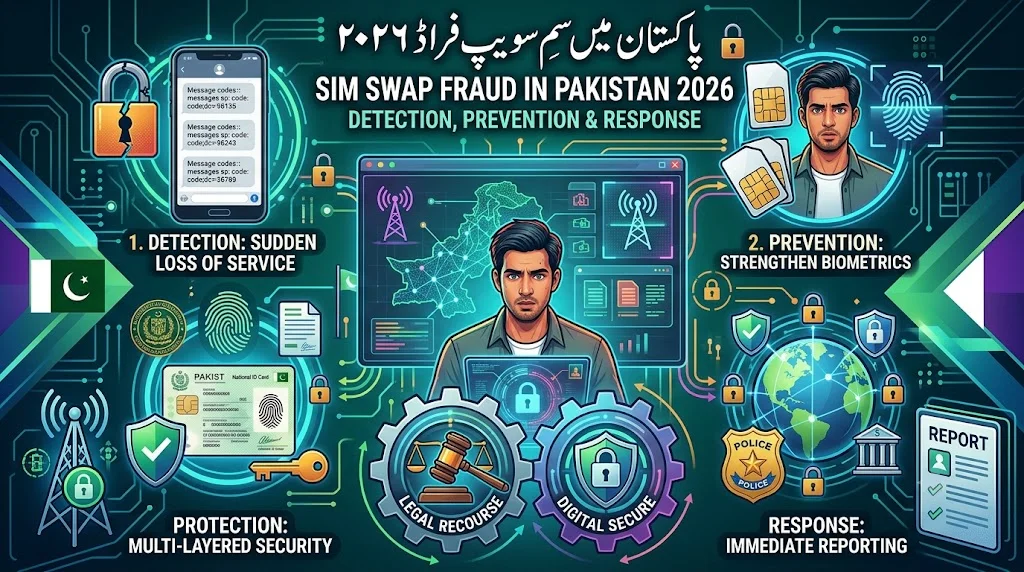
SIM swap fraud sits at a uniquely dangerous intersection of telecom vulnerability and financial risk. Unlike simple unauthorized SIM registration, a SIM swap targets a number you’re already using and depending on — often the very number your bank, mobile wallet, and other critical services use to send one-time passwords (OTPs). This guide explains exactly how SIM swap fraud works in the Pakistani context, the warning signs that distinguish it from a normal network outage, and the concrete steps to prevent and respond to it.
For the broader framework of SIM ownership verification this fraud pattern exploits, see our flagship SIM Owner Details guide.
Quick Answer
SIM swap fraud occurs when a criminal manages to get your existing phone number reissued on a SIM they control, typically by exploiting weaknesses in an operator’s verification process, to intercept your banking OTPs and take over your financial accounts. The clearest warning sign is sudden, unexplained loss of signal with no reported network outage. If this happens, contact your operator’s helpline immediately, and separately alert your bank to freeze suspicious transactions while you investigate.
How SIM Swap Fraud Actually Works
Understanding the mechanics helps you recognize the pattern before it fully succeeds:
- Reconnaissance: The fraudster gathers information about the target — often through phishing, social engineering, or purchasing leaked personal data — including the target’s phone number, and sometimes partial CNIC information or other identifying details.
- Impersonation attempt: The fraudster contacts the target’s telecom operator, or in more sophisticated cases, a corrupt or deceived franchise employee, attempting to have the target’s number reissued on a new SIM the fraudster controls — sometimes by claiming the “original” SIM was lost or damaged.
- The swap: If successful, the target’s number becomes active on the fraudster’s SIM, while the target’s own phone suddenly loses signal, since the same number cannot be simultaneously active on two SIMs.
- Exploitation: With control of the number, the fraudster can now receive OTPs sent via SMS for the target’s banking apps, mobile wallets, and other accounts using SMS-based two-factor authentication, potentially enabling unauthorized transactions or account takeovers.
Why Pakistan’s Biometric System Makes This Harder — But Not Impossible
Pakistan’s mandatory biometric SIM verification, which matches an applicant’s fingerprint against NADRA’s central database before activation, is a significant defense against SIM swap fraud compared to countries relying solely on knowledge-based verification (like security questions or partial ID numbers). A successful SIM swap in Pakistan generally requires either:
- A compromised or corrupt franchise employee willing to bypass or falsify the biometric verification step.
- A stolen physical CNIC combined with a fraudulently obtained biometric match, which is significantly harder to achieve but not impossible in rare, targeted cases.
- Exploitation of a specific operational gap at a particular franchise, rather than a systemic vulnerability across the whole network.
This is genuinely reassuring context — SIM swap fraud in Pakistan tends to be a more targeted, resource-intensive attack than in some other countries, rather than an easily automated, mass-scale threat. However, “harder” doesn’t mean “impossible,” which is exactly why the detection and prevention steps in this guide matter.
Warning Signs You May Be Experiencing a SIM Swap
The Primary Signal: Sudden, Unexplained Signal Loss
If your phone suddenly shows “No Service” or “Emergency Calls Only” with no reported network outage in your area, and this persists for more than a few minutes, treat it as a potential SIM swap in progress rather than a routine glitch. Genuine network outages are typically reported by your operator or visible as a widespread issue affecting others nearby; a SIM swap affects only your specific number.
Secondary Signals
- Unexpected SMS notifications about a SIM replacement or number transfer you didn’t initiate.
- Banking or mobile wallet OTP requests you didn’t trigger, visible if you can still access those accounts through another channel (like a web browser rather than the app).
- Unusual account activity notifications from your bank arriving via email (since SMS may be compromised) that you didn’t authorize.
Immediate Response If You Suspect a SIM Swap
- Contact your telecom operator’s helpline immediately using an alternate phone if your own has lost signal — Jazz (111), Zong (310), Telenor (345), Ufone (333) — and report a suspected unauthorized SIM swap.
- Alert your bank(s) directly, ideally through a phone call to their official fraud hotline, to request an immediate freeze or enhanced monitoring on your accounts while you investigate.
- Change passwords for any accounts where you still have access through channels other than SMS (email-based login, banking apps still logged in on another device).
- Visit the telecom franchise in person with your original CNIC to formally reclaim your number and reverse the unauthorized swap.
- File a complaint with the National Cyber Crime Investigation Agency (NCCIA) if you can confirm the swap was fraudulent and any financial loss occurred.
Preventing SIM Swap Fraud Before It Happens
Reduce Your Public Information Footprint
SIM swap attacks typically start with reconnaissance — the fraudster needs some baseline information about you to attempt the impersonation. Being cautious about what personal information (full name, date of birth, phone number) you share publicly on social media reduces the raw material available for this kind of targeted attack.
Use App-Based Authentication Where Possible
Where your bank or financial service offers app-based authentication (a dedicated authenticator app, or in-app push notifications) as an alternative to SMS-based OTPs, this significantly reduces your SIM-swap exposure, since the authentication no longer depends solely on controlling your phone number.
Set Up a PIN or Additional Verification With Your Operator
Some Pakistani operators offer an additional account PIN or security question that must be provided before any SIM replacement or transfer request is processed. Contact your operator’s helpline to ask whether this feature is available and enable it if so — this adds a meaningful barrier beyond the standard biometric check.
Monitor Your SIM Registration Status Regularly
The same monthly 668 check habit recommended throughout our SIM Owner Details guide also helps with SIM swap awareness — while 668 shows your total SIM count rather than specifically flagging a swap, an unexpected change in your registered count can be an early indicator worth investigating.
Keep Your CNIC Secure
Since a stolen physical CNIC is one of the pathways that makes SIM swap fraud easier to execute, the prevention steps covered in our CNIC Stolen guide — including avoiding unnecessary carrying of your original card and marking any photocopies with their specific purpose — double as SIM-swap prevention measures.
SIM Swap Fraud vs Other SIM-Related Risks
It’s worth distinguishing SIM swap fraud from the related but different risk of unauthorized SIM registration covered in our Unknown SIM Registered on My CNIC guide. Unauthorized registration typically involves a new SIM being added to your CNIC without your knowledge, discoverable through a routine 668 check. SIM swap fraud, by contrast, targets a number you’re actively using, and its primary symptom is sudden signal loss rather than an elevated SIM count — though both ultimately stem from weaknesses in the same registration and verification infrastructure.
The Financial Institution’s Role
Pakistani banks and mobile wallet providers have their own fraud-detection systems that sometimes catch SIM swap attempts independently — unusual transaction patterns, geographic anomalies, or rapid successive high-value transfers can trigger automatic holds even before you notice the signal loss yourself. This is one reason keeping your contact information (including a secondary email address) current with your bank matters — it gives them an alternate channel to reach you if SMS-based communication has been compromised by a swap.
Legal Consequences for SIM Swap Fraudsters
SIM swap fraud in Pakistan falls under multiple overlapping legal provisions. The unauthorized acquisition and use of your identity information to execute the swap violates Section 16 of the Prevention of Electronic Crimes Act (PECA) 2016, carrying penalties of up to three years’ imprisonment and a fine of up to Rs. 5 million. If the swap results in financial theft, this can additionally trigger fraud-related provisions under Pakistan’s broader criminal law framework. The National Cyber Crime Investigation Agency (NCCIA) is the appropriate body for formal complaints combining both the telecom-fraud and financial-fraud dimensions of a SIM swap case.
What Telecom Operators Are Doing to Combat SIM Swap Fraud
Pakistani operators have progressively strengthened their SIM replacement and transfer processes in response to this fraud pattern, including stricter biometric re-verification requirements and, in some cases, mandatory waiting periods or additional confirmation steps for SIM replacement requests. PTA’s broader enforcement initiatives — including the 365-day disowning rule introduced in May 2026 — while primarily targeting other forms of SIM misuse, also indirectly raise the friction involved in any fraudulent SIM manipulation, including swap attempts, by making the overall registration and transfer system more tightly monitored.
Real-World Impact: Why SIM Swap Fraud Is Financially Dangerous
The reason SIM swap fraud receives so much attention from security researchers, despite being harder to execute than simple phishing, is the scale of access it can provide once successful. A single successful swap potentially gives a fraudster access to:
- Every service using SMS-based two-factor authentication tied to that number — banking apps, mobile wallets, email account recovery, and social media account recovery.
- Password reset flows for services that use SMS verification as their primary account recovery method, potentially cascading into a broader account takeover beyond just financial services.
- A window of trust with anyone who calls the number expecting to reach you, since the fraudster now controls incoming calls to that line as well.
This cascading risk is exactly why prevention and rapid detection matter so much more for SIM swap fraud than for many other identity-related risks — a single successful swap can unlock multiple accounts nearly simultaneously, rather than exposing just one isolated piece of information.
How Banks Are Adapting Their Own Defenses
Beyond the telecom-side protections covered above, Pakistani financial institutions have increasingly layered additional verification steps on top of simple SMS OTPs specifically because of SIM swap risk:
- Device fingerprinting, where a bank’s app recognizes and flags login attempts from unfamiliar devices even if the correct OTP is provided.
- Behavioral analysis, flagging transactions that deviate significantly from your normal spending patterns for additional manual review.
- Multi-channel confirmation, where high-value transactions may require confirmation through both SMS and a separate email or app-based notification, reducing the impact of a compromised SMS channel alone.
Understanding that your bank likely has these additional safeguards doesn’t mean you can be complacent about SIM swap prevention — it simply means the overall system has multiple layers of defense, and your own vigilance is one important layer among several.
Frequently Asked Questions
What is the clearest sign of a SIM swap in progress? Sudden, unexplained loss of phone signal with no reported network outage in your area — this is the single most reliable early warning sign.
How does Pakistan’s biometric system affect SIM swap risk? It makes SIM swap fraud significantly harder than in countries relying only on knowledge-based verification, since a successful swap generally requires either a compromised franchise employee or a stolen CNIC combined with fraudulent biometric matching.
What should I do the moment I suspect a SIM swap? Contact your telecom operator’s helpline immediately from an alternate phone, alert your bank to freeze suspicious activity, and visit a franchise in person with your original CNIC.
Can SIM swap fraud happen without physical access to my CNIC? It’s significantly harder, since biometric verification is required for SIM transfers, but a compromised or corrupt franchise process remains a theoretical risk even without your physical CNIC, which is why operator-side PIN protections add valuable extra defense.
Does the monthly 668 check help detect SIM swaps? Indirectly — it helps you monitor your overall SIM count, though the primary symptom of an active swap is signal loss rather than a change in your registered total, so signal monitoring remains your most reliable early warning signal.
Should I use app-based authentication instead of SMS OTPs? Where available, yes — this reduces your exposure to SIM swap fraud since authentication no longer depends solely on controlling your phone number.
What legal action can I take after a SIM swap? File a complaint with the National Cyber Crime Investigation Agency (NCCIA), referencing PECA 2016 Section 16 for the unauthorized identity/SIM misuse, and pursue any financial fraud claims with your bank separately.
Can I set up extra protection against SIM swaps with my operator? Some operators offer an additional account PIN or security question for SIM replacement requests — contact your specific operator’s helpline to check availability, and enable this feature proactively rather than waiting until after an incident occurs.
Is SIM swap fraud common in Pakistan? It occurs, though Pakistan’s mandatory biometric verification makes it comparatively harder to execute at scale than in some other countries, making it more of a targeted risk than a mass-scale threat affecting the general population indiscriminately.
How is SIM swap fraud different from unauthorized SIM registration? Unauthorized registration adds a new SIM to your CNIC without your knowledge; SIM swap fraud takes over a number you’re actively using, with signal loss as the primary symptom rather than an elevated SIM count visible only through a periodic 668 check.
Final Word
SIM swap fraud represents one of the more financially dangerous risks in Pakistan’s digital identity landscape precisely because it targets accounts you’re actively depending on, not just an abstract SIM count. The good news is that Pakistan’s biometric verification framework provides real, meaningful protection compared to weaker systems elsewhere — and the detection signs (sudden signal loss above all) are distinctive enough that vigilant citizens can respond quickly when something is wrong. Combine the prevention steps in this guide with the broader monthly self-check habit from our SIM Owner Details guide, and you’ve covered the most consequential SIM-related financial risk available to any Pakistani mobile subscriber today.
Ultimately, SIM swap protection isn’t about achieving perfect, anxiety-driven vigilance — it’s about building a small set of durable habits (app-based authentication where available, periodic SIM checks, cautious sharing of personal information) that collectively reduce your exposure without requiring constant active effort. Once these habits are in place, they largely run in the background of your normal digital life, providing meaningful protection with minimal ongoing cost in time or attention.
This guide is for general informational purposes and reflects publicly available PTA and NADRA policy as understood at the time of writing. Always confirm current procedures directly on pta.gov.pk. See our Disclaimer and Privacy Policy for full details. Questions? Contact Us. This page is reviewed periodically as fraud patterns and operator security measures evolve.